Print-on-Demand Is the Fastest Way to Kill Your Fashion Brand Before It Even Starts
An exploration of what print on demand is and why we at Plakads Apparel do not provide that service. A good read if you want to start your brand in that direction!
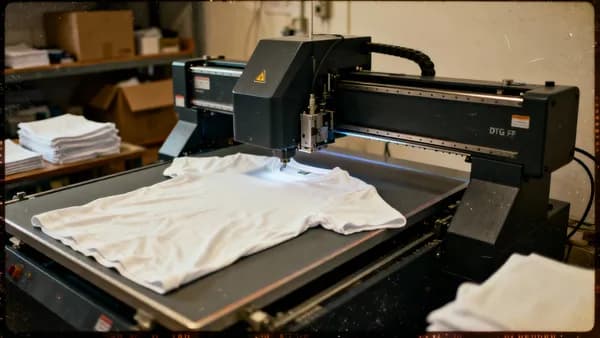
Print-on-demand looks like the miracle shortcut every Canva-powered hustler wants: no inventory, no warehouse, no upfront risk. It’s seductive — until you realize you handed the two most important things in fashion to someone else: product control and customer data. If you want a novelty tee that rides a meme for two weeks, POD will do the job. If you want a fashion brand that lasts longer than a single viral post, POD is the fastest way to sabotage your future.
Design is not a JPEG
A design that “pops on screen” and a garment that people choose to keep are different animals. Fashion lives in fabric, fit, and repeatability. It lives in how a neck rib behaves after ten washes, how the print holds on dark cotton, and whether a shoulder seam collapses after a month. POD gives you one sample and a hope. The batch your customers receive can be a different product entirely — different fabric lot, different ink curing, different operator skill. You cannot build loyalty selling inconsistent experiences. Your customers will not buy the story twice if the product fails them once.
Competing with hobbyists is not a strategy
The POD world is a crowded playground of hobby “brands” pumping out memes, quotes, and recycled motifs. Yes, you might edge above the noise with good marketing. But why build a business model that forces you to outshout an army of dilettantes instead of outbuilding a field of real competitors? When you manufacture and control your product, your competitive set shrinks from a million mediocre sellers to a few hundred serious brands that actually care about product. That’s where margins, storytelling, and customer retention become meaningful.
Data and control — who really owns your customer?
When fulfillment, order flow, and customer touchpoints live on someone else’s platform, you’re viral at their mercy. POD platforms see purchase patterns, repeat buyers, return reasons, region-level demand. In markets like India and Southeast Asia, where data governance is still a grey area, that’s not a theoretical risk — it’s an operational hazard. Your POD partner could replicate a winning design, undercut you, or quietly repurpose your audience insights. If you don’t control the pipeline, you don’t own the customer.
Speed is worthless if it teaches you nothing
Yes, POD is fast, until it isn't. You can try dozens of designs in a month. But what are you learning? You’re learning which JPEGs looked slick enough to impulse-buy. You’re not learning about fabric choices, shrinkage, dye-lot behavior, print durability, or the production trades that actually reduce costs long term. Those lessons only come from handling product at scale: sampling, controlled runs, QC checks, and vendor relationships. Skip those lessons and you’ll be forced to learn them later — when they’re expensive.
The smart alternative: Low MOQ manufacturing
Here’s the practical bridge that most founders ignore: low-MOQ manufacturing. It gives you the speed and risk control of POD, plus the product integrity and learning curve of real manufacturing. Start with minimums in the 20–300 piece range to validate demand, but do it on blanks and production lines you control. Use proven blank fabrics — 180 GSM single jersey for tees, 240 GSM French terry for sweatshirts, 350 GSM fleece for hoodies — so your samples match your bulk. Combine that with selective print methods (screen printing for longevity, high-quality DTF for complex color, embroidery for brand cues) and you get consistent deliverables customers actually keep.
Low MOQ setups let you iterate on fit, fabric, and finish instead of just image and copy. You still test quickly, but you test on a substrate that behaves predictably. You still avoid massive upfront inventory, but you build the operational muscle — vendor relationships, QC processes, spec sheets, packing standards — that scale into a real business. That’s not slow. That’s deliberate speed.
When POD makes sense — and when to move on
Use POD for rapid hypothesis testing: niche validation, creator merch, or one-off campaign items. The moment you start seeing repeat customers, predictable demand, or more than a handful of hits per design, shift to low-MOQ blanks. If your goal is a premium or mid-tier brand — anything that charges above impulse price points — you must move beyond POD before customer expectations expose the holes in your product.
If you’re building a business, you cannot outsource the part of the business that actually creates value. POD solves one problem — capital risk — while creating worse ones: inconsistent product, lost data, and zero operational competence. Low MOQ manufacturing solves for both speed and control. It lets you test without gambling the future, and it trains you to build a product people keep. If you want to be a real brand, act like it: own the product, own the customer, learn the craft. Shortcuts look attractive until they run out of runway.
apparel.plakads.com/blog/print-on-demand-is-the-fastest-way-to-kill-your-fashion-bran